
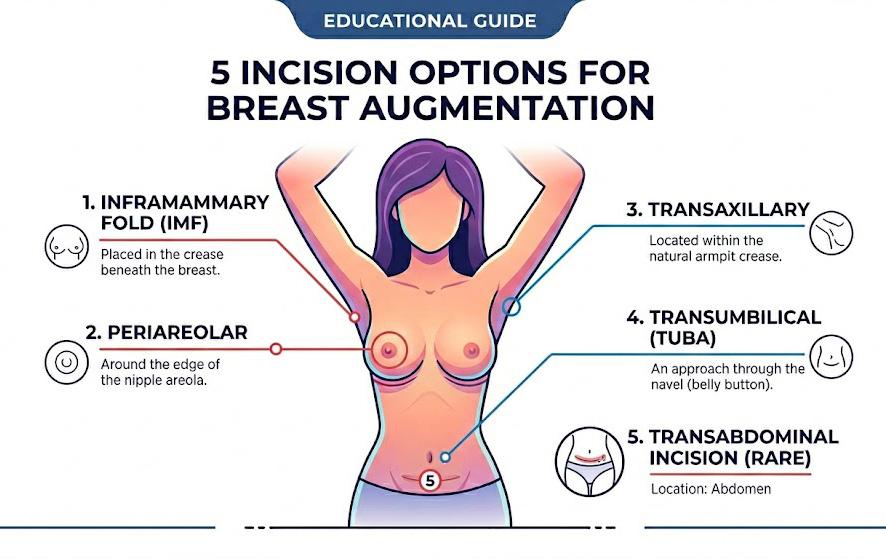
When considering breast augmentation, most patients focus on implant size, shape, or type, but one decision that significantly shapes your results, recovery, and scarring is the incision type. Where a surgeon makes the incision determines how the implant is placed, how visible the scar will be, and which implant options are available to you.
- What Is Breast Augmentation?
- Why Incision Choice Matters in Breast Augmentation?
- Overview of Breast Augmentation Incision Types
- 5 Types of Incisions for Breast Augmentation
- Breast Augmentation Incision Types Comparison Table
- Expert Insight from Seattle Plastic Surgery
- Which Breast Augmentation Incision Is Right for You?
- Recovery and Scar Healing by Incision Type
- Why Choose Seattle Plastic Surgery for Breast Augmentation?
- Final Thoughts
- FAQs
At Seattle Plastic Surgery, board-certified surgeons Dr. Tarak Patel and Dr. Craig Jonov take a personalized approach to every breast augmentation procedure. Before recommending an incision technique, they evaluate each patient’s anatomy, goals, and implant preferences. This patient-first planning is why so many women across Seattle trust the practice for natural-looking, long-lasting results.
You’ll learn everything you need to know about the five breast augmentation incision types, how they compare, and how to decide which one is right for you.
What Is Breast Augmentation?
Breast augmentation is a cosmetic procedure that enhances the size, shape, and overall balance of the breasts using implants. These implants are placed through carefully planned surgical incisions, and the choice of incision directly affects how the surgery is performed and how the results appear over time.
At Seattle Plastic Surgery, breast augmentation is approached with a focus on precision, safety, and natural-looking outcomes. Each treatment plan is tailored to the patient’s anatomy and goals, including the most suitable incision technique.
According to the American Society of Plastic Surgeons, breast augmentation continues to be one of the most commonly performed cosmetic procedures, with patients seeking improvements in both appearance and confidence.
Why Incision Choice Matters in Breast Augmentation?
Choosing an incision is not a minor detail. It is one of the most clinically meaningful decisions in breast augmentation surgery. Here is why:
- Scar visibility varies dramatically by incision location. Some placements hide scars within natural folds or pigmented skin; others leave marks in more exposed areas. Understanding this upfront helps patients make informed decisions rather than discovering limitations after surgery.
- Implant placement control is tied directly to incision access. Surgeons generally have the most precision and visibility when working through incisions closest to the breast. More distant incisions, such as those through the armpit or belly button, require different tools and offer less direct access, which can affect implant symmetry and positioning.
- Risk factors such as infection, changes in nipple sensation, and impact on breastfeeding ability are all influenced by incision placement. Incisions near the areola, for example, carry a slightly higher risk of sensory changes because of proximity to nerves and milk ducts.
Long-term results, including how implants settle, whether revision is easier or harder, and how scars fade over time, are all tied to incision selection.
Overview of Breast Augmentation Incision Types
There are four to five main incision types used in modern breast augmentation:
- Inframammary
- Periareolar
- Transaxillary
- Transumbilical (TUBA)
- Transabdomina
Before choosing, it’s important to understand how each technique works and when it is most appropriate.
5 Types of Incisions for Breast Augmentation
1. Inframammary Incision (Most Common)
The inframammary incision is placed in the natural fold beneath the breast and the crease where the breast meets the chest wall. It is the most widely used breast augmentation incision technique in the world, and for good reason.
Why surgeons prefer it: This approach gives the surgeon the clearest, most direct view of the surgical pocket. Implant positioning is precise, and adjustments are easier to make in real time. It also works with all implant types, such as silicone, saline, and gummy bear, and accommodates a range of implant sizes, including larger profiles.
Scar outcome: The scar sits within the breast fold and is typically hidden under a bra, swimsuit, or bikini top. Over time, it fades considerably, though a fine line remains.
Pros:
- Most precise implant placement
- Compatible with all implant types and sizes
- Lower complication rates overall
- Easier to access for revision surgery if needed
Cons:
- A scar is present under the breast, though usually concealed
Best for: First-time augmentation patients, those choosing larger implants, and patients wanting reliable precision and long-term revision access.
2. Periareolar Incision (Around the Nipple)
The periareolar incision follows the lower edge of the areola and the darker pigmented skin surrounding the nipple. Because the scar forms at the border between two skin tones, it tends to be less visible than incisions on uniform skin.
Why patients choose it: The natural pigment transition camouflages the scar well for many patients, particularly those with larger or darker areolas. This approach also allows the surgeon to adjust the areola size or shape during the same procedure, which can be useful for patients seeking a more proportionate appearance.
Scar outcome: The scar blends into the areola border and is generally difficult to detect once healed, especially with proper scar care.
Pros:
- Scar integrates naturally with areola pigmentation
- Option to resize or reshape the areola simultaneously
- Good access for moderate implant sizes
Cons:
- Slightly higher risk of reduced nipple sensation due to proximity to nerves
- Potential impact on breastfeeding if milk ducts are affected
- Not ideal for very large implants
Best for: Patients who also want areola adjustment, those with a well-defined areolar border, and patients choosing smaller to moderate implants.
3. Transaxillary Incision (Underarm / Armpit)
The transaxillary breast augmentation approach places the incision in the natural crease of the underarm. Because the scar is located entirely away from the breast, this technique appeals to patients who want to avoid any visible marks on the chest.
Why patients choose it: No scars on the breast itself. When healed, the small mark in the underarm fold is generally easy to conceal and fades into the natural skin texture of that area.
Scar outcome: Scar is located in the axilla (underarm), not on the breast. Visibility depends on how much time is spent with arms raised.
Pros:
- No scar on the breast tissue or surrounding skin
- Natural-looking results when performed well
Cons:
- Requires more specialized technique and experience
- Less direct access means slightly reduced precision for implant positioning
- May not be ideal for all implant types or sizes
- More complex if a revision is ever needed
Best for: Patients prioritizing a “scarless breast” appearance, those with smaller to moderate implant goals, and patients whose anatomy supports this approach.
4. Transumbilical Incision, TUBA (Belly Button)
The transumbilical breast augmentation (TUBA) approach places the incision inside the navel. A tunnel is created under the skin, and saline implants are guided into position, then filled once placed.
Why some patients consider it: No scars on the breast, no scars on the chest, just a hidden mark inside the belly button.
Scar outcome: Hidden within the navel; essentially invisible once healed.
Pros:
- Zero visible breast scarring
- Appealing to patients with scar concerns
Cons:
- Only compatible with saline implants (silicone implants cannot be passed through this route unfilled)
- Least direct surgical access of all techniques
- Lower precision for implant positioning
- Not widely offered; requires highly specific training
Best for: Carefully selected patients who want saline implants and have no concern about limited placement control.
5. Transabdominal Incision (Rare)
A patient often undergoes a tummy tuck along with this approach, which uses an abdominal incision. As a standalone incision, it is rarely used outside of combination procedures for breast augmentation.
Pros:
- Allows combination with abdominal surgery
- No additional incision on the breast
Cons:
- Not used as a standalone breast augmentation technique
- Limited surgical control compared to other approaches
- Rarely performed in modern practice
The U.S. Food and Drug Administration emphasizes that while breast augmentation is generally safe, patients should be aware of potential risks such as infection, implant complications, and the possibility of future revision procedures.
Breast Augmentation Incision Types Comparison Table
|
Incision Type |
Scar Location | Surgeon Precision | Implant Compatibility |
| Inframammary | Under the breast fold | High |
All types |
|
Periareolar |
Areola border | Medium | Moderate sizes |
| Transaxillary | Underarm | Medium |
Most types |
|
TUBA |
Inside navel | Low | Saline only |
| Transabdominal | Abdomen | Low |
Limited |
Expert Insight from Seattle Plastic Surgery
Choosing the right breast augmentation incision type depends on more than comparing scar placement or recovery timelines. It also depends on the surgeon’s experience, understanding of breast anatomy, and ability to recommend the technique that fits the patient’s body, implant goals, and long-term expectations.
At Seattle Plastic Surgery, breast augmentation consultations are guided by experienced surgeons who focus on safety, natural-looking results, and personalized surgical planning.
Dr. Tarak Patel
Dr. Tarak Patel is a double board-certified plastic and general surgeon at Seattle Plastic Surgery. His background includes plastic and reconstructive surgery, and his approach focuses on safe, comfortable care with personalized incision planning tailored to each patient’s anatomy.
Dr. Craig Jonov
Dr. Craig Jonov is a cosmetic surgeon with more than 20 years of experience providing advanced aesthetic procedures for patients in Seattle and nearby areas. His work includes a high volume of breast procedures, including breast augmentation, breast lift, and combination surgeries.
Looking for the best incision for breast implants? Schedule a consultation at Seattle Plastic Surgery to receive a customized surgical plan designed around your goals.
Which Breast Augmentation Incision Is Right for You?
Many factors influence which incision works best for a given patient:
- Breast size and shape: Patients with a well-defined breast fold are often excellent candidates for the inframammary incision breast augmentation approach. And, patients with larger areolas may do well with periareolar. Those with very little breast tissue may benefit from transaxillary.
- Implant type and size: Silicone implants and larger implants generally require the inframammary or periareolar approach for adequate placement. TUBA is limited to saline.
- Scar tolerance: If minimal visible scarring is a top priority and anatomy supports it, transaxillary or TUBA may be considered.
- Future plans: Patients who may want revision surgery, additional volume, or a future breast lift benefit from the inframammary approach, which offers the clearest access for follow-up procedures.
- Lifestyle: Patients who are frequently in swimwear or athletic clothing may weigh underarm visibility against breast fold visibility differently.
At Seattle Plastic Surgery, every breast augmentation plan is customized to your anatomy and goals. No incision type is recommended without a thorough evaluation of your breast tissue, skin quality, implant preference, and desired outcome. The consultation is where these decisions take shape.
Recovery and Scar Healing by Incision Type
All breast augmentation in Seattle incisions heal in similar phases, like initial closure, followed by weeks of gradual fading. That said, incision placement affects practical recovery in a few ways:
- Inframammary scars are generally easy to care for and stay protected under clothing. Silicone gel or sheets are often introduced around four to six weeks post-op once incisions are fully closed.
- Periareolar scars may require more careful monitoring given their proximity to sensitive tissue. Sensation changes, if they occur, often improve over several months.
- Transaxillary incisions in the underarm can feel slightly tender when raising the arm during early recovery. Avoiding overhead movements during the first week reduces discomfort.
- TUBA scars in the navel are generally well-protected and heal with minimal visibility, though the limited access during surgery means follow-up imaging may be more important.
Most patients return to desk work within one to two weeks.
Why Choose Seattle Plastic Surgery for Breast Augmentation?
Seattle Plastic Surgery offers personalized treatment planning for patients considering breast augmentation in Seattle and other breast procedures. The practice focuses on experienced surgical care, natural-looking results, advanced incision techniques, and patient-specific recommendations.
Each of the five breast augmentation incision types can deliver excellent outcomes, but they are not interchangeable. The best incision is the one that matches the patient’s anatomy, implant choice, and aesthetic goals.
Final Thoughts
Selecting the right breast augmentation incision is a clinical decision, not a personal preference. Anatomy, implant type, and surgical goals determine the technique. A patient who chooses an incision solely based on scar placement or what they’ve seen online may be disappointed with long-term effects or placement precision.
Schedule a consultation at Seattle Plastic Surgery today. Dr. Tarak Patel and Dr. Craig Jonov are available to evaluate candidacy for breast augmentation and provide a transparent, personalized surgical plan.
FAQs
Which incision leaves the least visible scar?
Transaxillary and transumbilical approaches avoid placing scars directly on the breast, while inframammary incisions are typically well hidden within the natural breast fold. The final visibility of breast augmentation scars also depends on healing and surgical technique.
What is the safest breast augmentation incision?
The inframammary incision is often considered the most reliable option because it allows better visibility and control during surgery. Surgeons like Dr. Tarak Patel and Dr. Craig Jonov commonly use this approach when precision and implant positioning are top priorities.
Can incision choice affect results?
Yes. The type of incision used in breast augmentation directly impacts implant placement, symmetry, and long-term results. At Seattle Plastic Surgery, incision selection is always customized to ensure balanced, natural-looking outcomes.
Is scarless breast augmentation possible?
No surgical procedure is completely scarless. However, techniques such as transaxillary or transumbilical placement avoid scars on the breast itself. With expert planning by surgeons like Dr. Craig Jonov, scars are typically minimal and strategically placed for the best cosmetic result.

Dr. Craig Jonov is a board-certified cosmetic surgeon based in Lynnwood, serving the Seattle area. With extensive training in facial, breast, and body procedures, he combines surgical expertise with artistic precision to achieve natural-looking results. Dr. Jonov also specializes in advanced injectable treatments and non-surgical rejuvenation techniques. Recognized for his commitment to safety and innovation, he is an active member of leading cosmetic surgery organizations and is dedicated to providing personalized care tailored to each patient’s goals.