
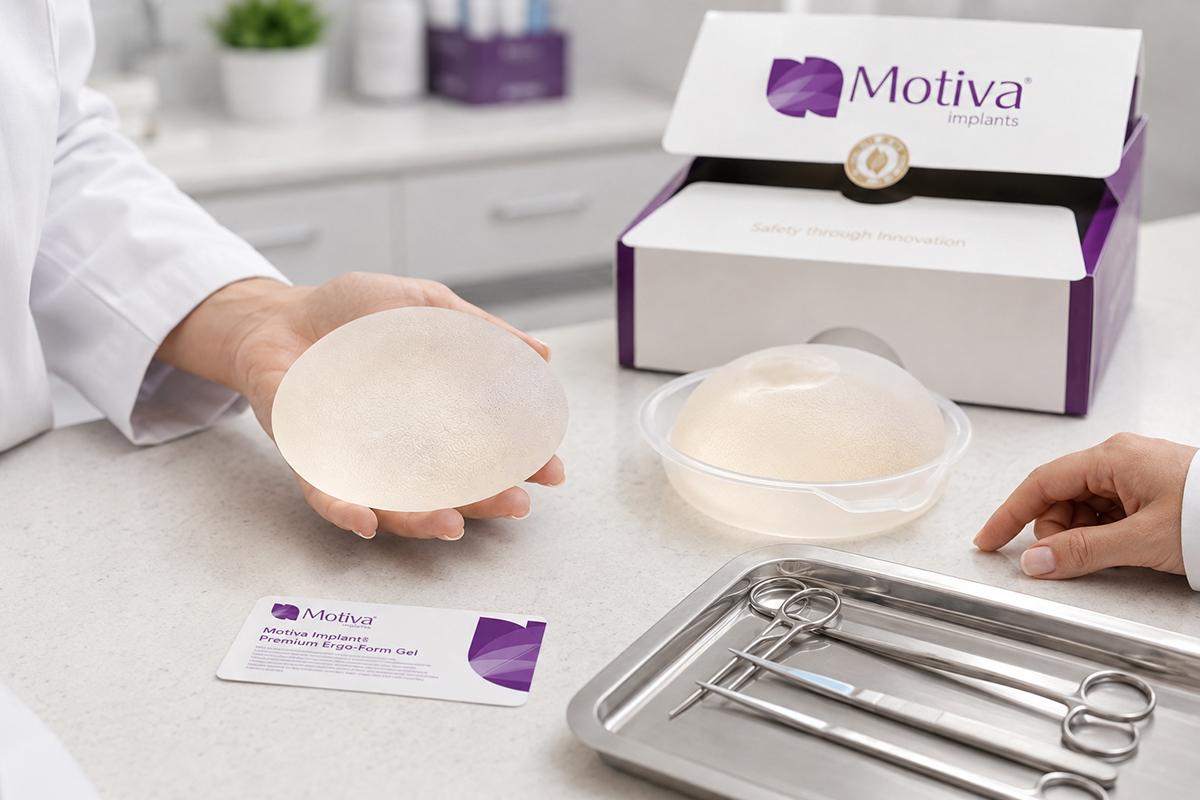
Choosing a breast implant involves more than looking at the cc number. A Motiva implant size chart also shows measurements such as base width, projection, and, for some designs, height and arc length. These details help a plastic surgeon compare an implant with the breast’s natural width and shape.
- What Does the Motiva Implant Size Chart Show?
- What Do Mini, Demi, Full, and Corsé Mean?
- Motiva Breast Implant Families Shown in the Size Charts
- Why the Same CC Can Look Different?
- Motiva Implant Size vs Profile: What’s the Difference?
- Does a Larger Motiva Implant Mean a Larger Cup Size?
- Are All Motiva Implant Sizes Available in the U.S.?
- Can You Choose Your Motiva Implant Size From the Chart?
- Motiva Implant Size Chart vs Actual Breast Size
- Motiva Breast Implants Before and After Results
- Motiva Implant Sizing at Seattle Plastic Surgery
- Meet Your Motiva® Breast Implant Surgeon
- Schedule Your Motiva Breast Implants Consultation
- FAQs
Each chart displays the implant’s volume in cc alongside important dimensions like base width, projection, and, in some designs, height and arc length. These measurements allow a plastic surgeon to determine which implant options can fit a patient’s unique breast and chest anatomy.
Seattle Plastic Surgery offers information on several Motiva breast implant families, each with its own sizing chart. Knowing what the measurements mean can make it easier to understand the options discussed during a breast augmentation consultation.
What Does the Motiva Implant Size Chart Show?
A Motiva breast implant size chart is essentially a detailed specification sheet. Think of it like the measurements for a piece of clothing. Knowing that a shirt is “size medium” tells part of the story, but knowing the chest width, sleeve length, and body length tells much more about how it might actually fit.
Volume (cc)
Volume measures how much space the implant fills, expressed in cubic centimeters. One cc equals one milliliter of liquid. Motiva implant volumes vary by implant family and market. International charts may show a wider range of sizes than the current U.S. approved portfolio.
A common misconception is that higher cc automatically means a bigger result. In reality, how that volume is distributed across the implant’s width and projection significantly affects the final look.
Base Width
Base width measures how wide the implant sits when placed inside the breast. This measurement is critical because it needs to work with the natural width of the breast and chest wall.
An implant that is too wide for a patient’s anatomy may extend beyond the natural breast boundaries. An implant that is too narrow may leave visible gaps at the sides. Either situation may make it harder to achieve the intended fit and shape.
A wider implant is not automatically better. Breast base width is one of the measurements a surgeon uses when comparing Motiva implant options.
Projection
Projection measures how far forward the implant extends from the chest wall. This dimension affects how much fullness appears when viewing the breast from the side.
Lower projection implants sit flatter against the chest and create a more subtle slope. Higher projection implants extend further forward and create more visible fullness, particularly in the front view.
The Motiva implant profiles use profile names such as Mini, Demi, Full, and Corsé to describe differences in projection. Understanding these terms helps patients communicate their goals more clearly during consultations.
Height
Height becomes particularly important for oval and anatomical implant designs. Round implants have equal dimensions in all directions, so width and height are the same. Oval and anatomical implants are taller than they are wide, or vice versa, which means height must be specified separately.
For example, the Motiva Ergonomix Oval chart includes both width and height measurements because these implants are designed to create a more vertically oriented shape.
Arc Measurements
Some Motiva charts include arc measurements that describe the implant’s curvature. These measurements give the surgeon more information about the implant’s shape and how it may fit against the chest.
Catalog Number
Each implant in the Motiva system has a catalog number that identifies its exact specifications. For example, a number like ERSM-400 breaks down as follows:
- ER indicates the implant family (Ergonomix Round)
- S indicates the surface type (SmoothSilk)
- M indicates the profile (Mini)
- 400 indicates the volume in cc
The codes are mainly used to identify the exact implant configuration. Patients do not need to memorize them, but they can be useful when comparing options.
What Do Mini, Demi, Full, and Corsé Mean?
The terms Mini, Demi, Full, and Corsé describe breast implant projection profiles, not size categories. This distinction is important because many patients initially assume these terms work like small, medium, large, and extra-large. They do not.
Profile describes how far forward an implant projects relative to its breast implant base width, not how big the implant is overall.
Motiva Mini
Motiva Mini implants have the lowest projection in the Motiva system. They feature a wider, flatter relationship between base and forward extension.
A Mini profile may be appropriate for patients who want a subtle enhancement or who have a wider chest and prefer the implant to spread across more of the breast area rather than projecting significantly forward. The result tends to be a gentle, natural slope.
Motiva Demi
Motiva Demi implants offer more projection than Mini while maintaining a balanced relationship between width and forward extension.
This profile can work well for patients seeking noticeable enhancement without extreme forward projection. Demi implants create a moderately rounded shape that many patients describe as naturally proportioned.
Motiva Full
Motiva Full implants have a higher projection than Mini or Demi implants. They create more visible forward fullness, particularly in the upper portion of the breast.
Patients who want a fuller, more prominent appearance often consider Full profile implants. The higher projection creates more cleavage potential and a rounder front view.
Motiva Corsé
Motiva Corsé implants have the highest projection in the Motiva profile system. They feature a narrower base relative to their forward projection.
Corsé may be appropriate for patients who want maximum enhancement and significant forward fullness. Because the base is narrower relative to projection, Corsé implants can create a more dramatic look without requiring an extremely wide implant.
Motiva Breast Implant Families Shown in the Size Charts
Seattle Plastic Surgery’s information references several distinct Motiva implant families. Each family has its own Motiva breast implant sizes with specific measurements. Understanding the differences helps explain why one chart may show different columns than another.
Motiva® Ergonomix® Round
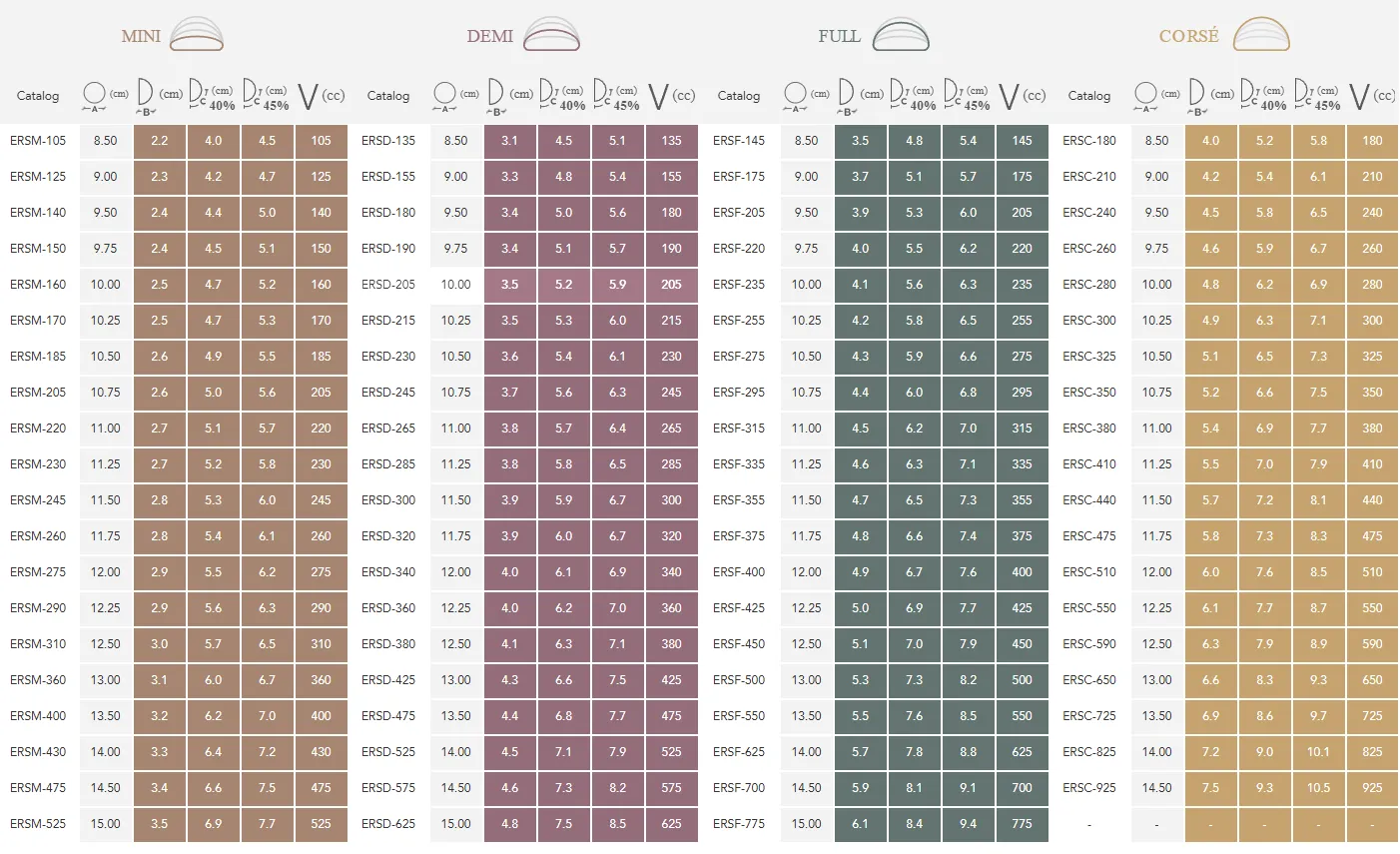
The Motiva Ergonomix line uses codes such as ERSM, ERSD, ERSF, and ERSC to identify the Mini, Demi, Full, and Corsé profiles, respectively.
The Motiva Ergonomix implant size chart typically shows:
|
Column |
What It Measures |
| Catalog Code |
Specific implant identifier |
|
Volume (cc) |
Implant volume |
| Base (cm) |
Width of the implant |
|
Projection (cm) |
Forward extension |
| Arc measurements |
Curvature specifications |
Ergonomix implants use a gel designed to respond to body position. When a patient is standing, the gel settles slightly toward the bottom, mimicking natural breast tissue. When lying down, the gel distributes more evenly. This behavior distinguishes Ergonomix from traditional round implants.
Motiva® Ergonomix2®
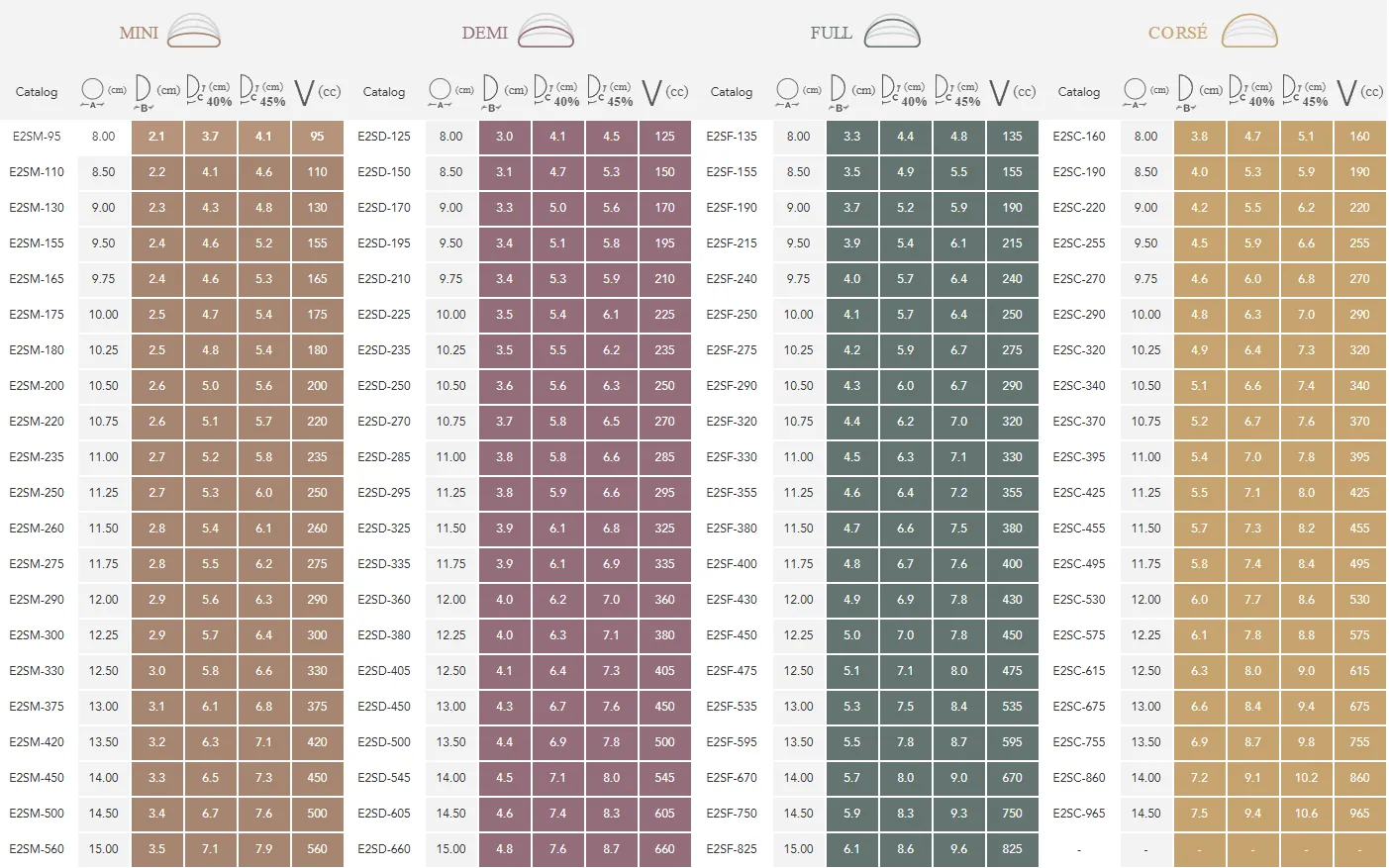
Motiva Ergonomix Oval has an oval-shaped footprint. This gives the implant a different width-to-height relationship from a traditional round design. The chart uses codes like E2SM, E2SD, E2SF, and E2SC.
The chart organization is similar to the original Ergonomix chart, with columns for volume, base width, and projection. Motiva Ergonomix2 has its own size chart with measurements that help describe the implant’s dimensions and projection. The exact options depend on the product line and market.
Motiva® Ergonomix Oval®
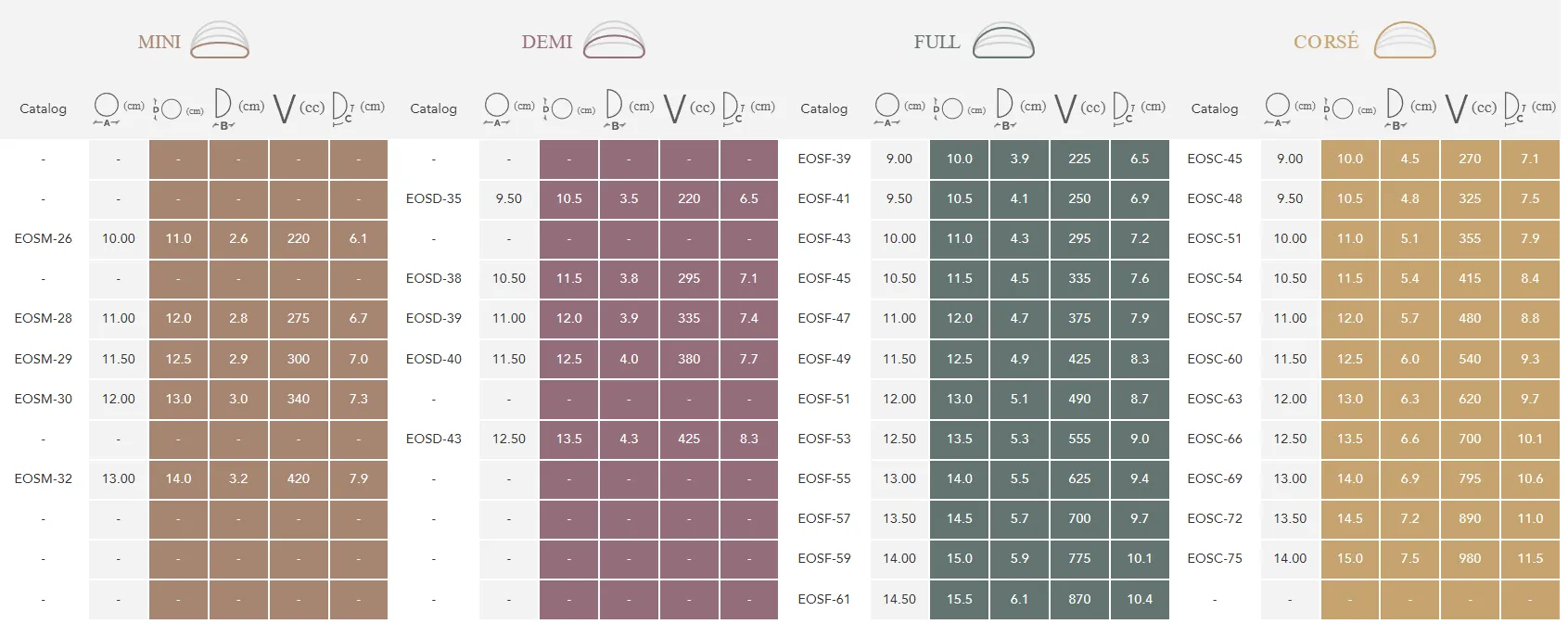
Motiva Ergonomix Oval has an oval-shaped footprint. This gives the implant a different width-to-height relationship from a traditional round design.
Its size chart includes measurements for width, height, projection, vertical arc, and volume. These extra measurements can be useful when the shape of the natural breast or chest calls for a more vertically oriented implant design.
The important point about Motiva Ergonomix Oval is that an implant cannot be described fully by its cc volume. Its height and width also help define how it will fit.
Motiva® Anatomical TrueFixation®
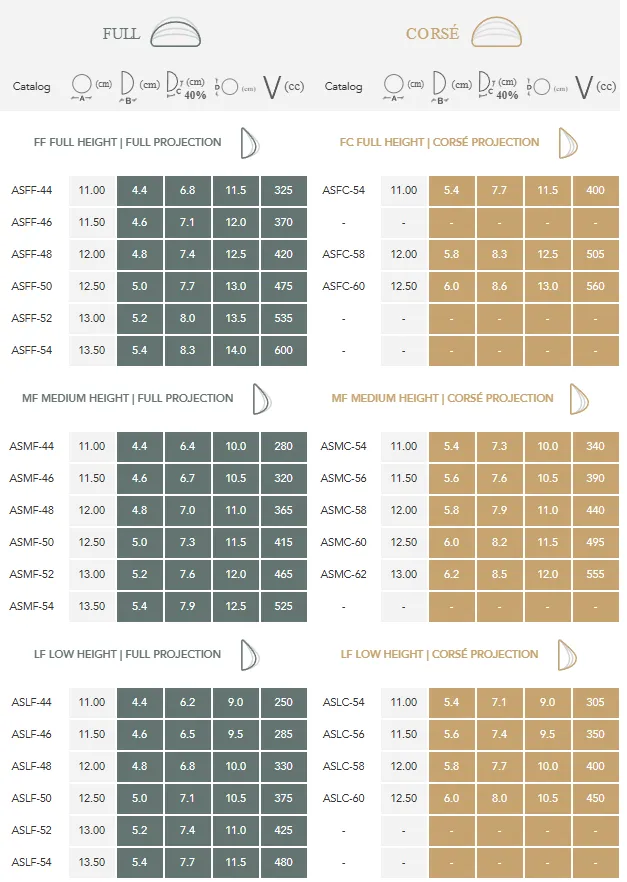
Motiva Anatomical TrueFixation has an anatomical, or teardrop-shaped, design. Its shape places greater emphasis on the implant’s vertical form and its position within the breast.
The size chart provides measurements such as base width, height, projection and arc length. Also, Motiva Anatomical TrueFixation uses combinations such as FF, FC, MF, MC, LF and LC to identify different implant configurations.
|
Code |
Height | Proejction |
|
FF |
Full height | Full projection |
| FC | Full height |
Corsé projection |
|
MF |
Medium height | Full projection |
| MC | Medium height |
Corsé projection |
|
LF |
Low height |
Full projection |
| LC | Low height |
Corsé projection |
The chart includes columns for base width, height, projection, inferior arc, and volume. This level of detail exists because anatomical implants are shaped to mimic the natural breast slope, with more fullness at the bottom and a tapered upper pole.
Motiva® Round SmoothSilk® PLUS
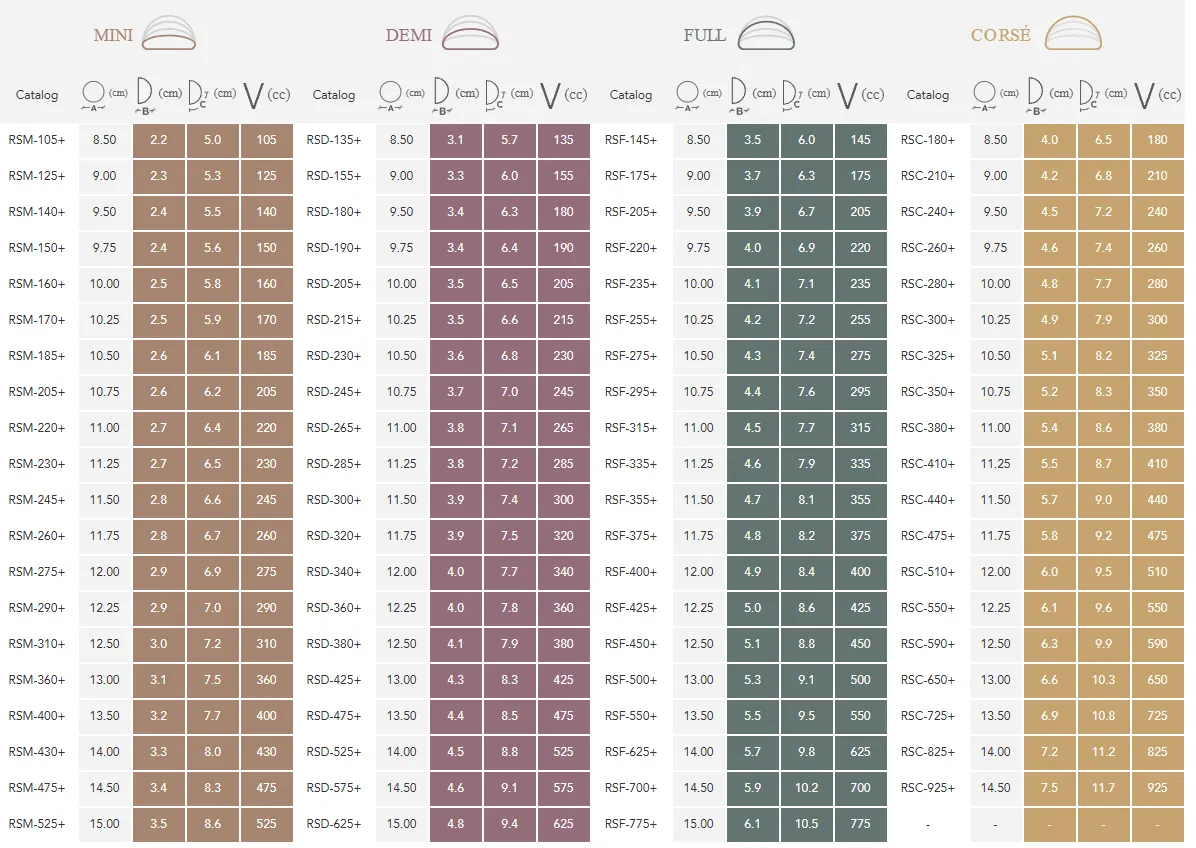
Motiva Round SmoothSilk PLUS is a round implant design that uses the traditional round shape, available in Mini, Demi, Full, and Corsé profiles. A round implant can provide a different distribution of fullness from an anatomical or oval design.
This is why the chart is useful for comparing breast implant dimensions, but it cannot show exactly how a particular implant will look on an individual breast.
Motiva offers several implant families worldwide, but the options approved by the FDA in the U.S. are more limited. In the U.S., the approved Motiva implants include specific SmoothSilk Round and SmoothSilk Round Ergonomix models.
Why the Same CC Can Look Different?
One of the most important concepts in breast implant sizing is that identical volume does not guarantee identical appearance.
300cc Does Not Always Mean the Same Shape
Consider two hypothetical implants, both containing 300cc of silicone gel:
Implant A:
- 300cc volume
- 13cm base width
- 3.8cm projection
Implant B:
- 300cc volume
- 11cm base width
- 5.2cm projection
Both implants hold the same amount of silicone. But Implant A spreads that volume across a wider, flatter shape, while Implant B concentrates it into a narrower, more projecting shape.
In the same patient, Implant A might produce a wider, subtler enhancement. Implant B may create greater forward fullness, while Implant A may distribute the same volume over a wider base. The volume is the same, but the different dimensions can affect how the Motiva implant volume fits and how the breast may look.
Motiva Implant Size vs Profile: What’s the Difference?
A quick reference helps clarify the terminology:
|
Chart Term |
What It Tells You |
|
CC (Volume) |
How much space the implant fills |
| Base Width |
How wide the implant sits |
|
Projection |
How far forward it extends |
| Height |
Vertical dimension (for oval/anatomical) |
|
Profile |
Projection category (Mini, Demi, Full, Corsé) |
| Catalog |
Specific implant identifier |
Does a Larger Motiva Implant Mean a Larger Cup Size?
Not necessarily. Cup size cannot be predicted precisely from implant volume. The final breast size depends on several factors, including:
- Starting breast size
- Existing breast tissue
- Chest and breast width
- Implant volume and profile
- Implant dimensions and placement
- Skin elasticity
- Breast shape and asymmetry
Bra sizing itself is not standardized between manufacturers, which makes statements such as “300 cc equals a C cup” unreliable.
Are All Motiva Implant Sizes Available in the U.S.?
No. Motiva has an international catalog with several implant families and configurations, but the FDA approved specific Motiva SmoothSilk Round and SmoothSilk Round Ergonomix silicone gel-filled breast implants for use in the U.S.
The FDA approval was issued on September 27, 2024, for breast augmentation in women at least 22 years old.
Global Motiva catalogues may show implant options that are not currently available in the United States. When reviewing any Motiva implant size chart, patients should understand that not every listed configuration may be accessible through U.S. surgeons.
Can You Choose Your Motiva Implant Size From the Chart?
No. The chart is a reference tool, not a self-selection tool. The chart shows which implant configurations exist and their dimensions. It cannot determine which implant is appropriate for a specific body.
The surgeon must consider:
- Breast width
- Chest wall anatomy
- Existing breast tissue
- Tissue coverage
- Skin characteristics
- Breast asymmetry
- Desired projection
- Desired volume
- Surgical approach
An implant that looks ideal on paper may not be the best option once the breast and chest are measured. The chart helps the surgical team compare implant dimensions with the patient’s anatomy and goals.
Motiva Implant Size Chart vs Actual Breast Size
The chart cannot predict:
- Exact cup size after surgery
- Exact final breast appearance
- Exact cleavage amount
- Exact upper pole fullness
A size chart shows the physical dimensions of an implant. It cannot predict the exact breast size or appearance after surgery because the final result also depends on existing breast tissue, skin, breast shape, implant placement and surgical technique.
Motiva Breast Implants Before and After Results
Motiva before and after photos can help show how breast augmentation results may look on different body types and at different stages of healing. The gallery below features patients from Seattle Plastic Surgery.
Motiva Implant Sizing at Seattle Plastic Surgery
The implant sizing process at Seattle Plastic Surgery includes:
- Consultation: Discussion of goals, concerns, and expectations.
- Measurements: Detailed anatomical measurements to establish implant parameters.
- Profile discussion: Explanation of how Mini, Demi, Full, and Corsé profiles might work with the patient’s anatomy.
- Sizers: Opportunity to visualize approximate results using sizing tools.
- Goal review: Alignment between patient expectations and realistic outcomes.
- Final selection: Collaborative decision based on all gathered information.
These measurements give the surgical team a clearer picture of which implant dimensions may work with the existing breast and chest anatomy.
Meet Your Motiva® Breast Implant Surgeon
Dr. Tarak Patel, a double board-certified plastic and reconstructive surgeon, has more than 25 years of surgical experience. He takes a personalized approach to breast augmentation, considering breast shape, chest width, existing tissue, and aesthetic goals when discussing Motiva breast implants.
Dr. Patel considers how the implant’s size, width, and projection complement the patient’s natural breast shape and goals. During the consultation, he discusses the available options and explains how each may affect the final look.
The practice serves patients throughout Seattle and nearby areas, including Tacoma, Kirkland, and Bellevue.
Schedule Your Motiva Breast Implants Consultation
At Seattle Plastic Surgery, Motiva implant sizing considers the details behind the numbers, including breast width, implant base width, projection, and volume. Different sizes can be compared based on how they may fit the existing breast and the type of change being considered.
For anyone researching Motiva breast implants in Seattle, the next step is a conversation with the surgical team about the available sizes and profiles and how they relate to the natural breast shape.
FAQs
What is the smallest Motiva implant size?
The smallest Motiva implants start around 100-125cc, depending on the implant family. The exact minimum varies between product lines. For current U.S. availability, consulting with a board-certified plastic surgeon provides the most accurate information.
What is the largest Motiva implant size?
Global Motiva catalogs show implants exceeding 800 cc in some product lines. However, U.S. availability may differ from international catalogues. The largest appropriate size for any patient depends on anatomical factors, not catalogue maximums.
What does cc mean on a Motiva implant chart?
CC stands for cubic centimeters and measures the volume of the implant. One cc equals one milliliter. This number indicates how much silicone gel the implant contains.
What is the difference between Motiva Mini, Demi, Full, and Corsé?
These terms describe breast implant projection profiles. Mini has the lowest projection and widest base relative to projection. Demi offers moderate projection. Full provides higher projection. Corsé has the highest projection with a narrower base.
Does a higher profile mean a larger implant?
No. The profile describes projection relative to the base width, not the overall volume. A Mini profile implant and a Corsé profile implant can have identical cc volumes while looking very different.
What is the difference between Motiva Ergonomix and Round?
Motiva Ergonomix implants use a gel that responds to body position, settling slightly when standing and distributing when lying down. Traditional round implants maintain their shape regardless of position. Ergonomix may create a more natural movement pattern.
What is the Motiva Ergonomix implant size chart?
The Motiva Ergonomix implant size chart shows available Ergonomix round implants with specifications including catalog code, volume, base width, projection, and arc measurements.
Why does the Motiva Ergonomix Oval chart include height?
Oval implants are not symmetrical like round implants. They have different width and height measurements. The height column tells surgeons the vertical dimension of the implant, which affects how it fills the breast from top to bottom.
What do FF, FC, MF, MC, LF, and LC mean on the TrueFixation chart?
These codes identify height and projection combinations. F, M, and L indicate Full, Medium, or Low height. The second letter indicates Full or Corsé projection.
Are all Motiva implant sizes FDA approved in the U.S.?
No. The FDA approved Motiva SmoothSilk Round and SmoothSilk Round Ergonomix for breast augmentation in September 2024. International Motiva catalogues may include options not currently available in the U.S.
How does a surgeon decide which Motiva implant size is right for me?
A surgeon combines anatomical measurements, assessment of tissue characteristics, discussion of aesthetic goals, and professional experience to recommend appropriate options. The Motiva breast implants size chart provides the specifications. The surgeon provides judgment about which specifications suit each patient.
What is the cost of Motiva breast implants in Seattle?
At Seattle Plastic Surgery, Motiva breast implants start at $6,995, including the implants. The final cost can vary based on the implant type chosen and whether an additional procedure, such as a breast lift, is recommended. Financing options are also available through the practice to help make the procedure more manageable.

Dr. Craig Jonov is a board-certified cosmetic surgeon based in Lynnwood, serving the Seattle area. With extensive training in facial, breast, and body procedures, he combines surgical expertise with artistic precision to achieve natural-looking results. Dr. Jonov also specializes in advanced injectable treatments and non-surgical rejuvenation techniques. Recognized for his commitment to safety and innovation, he is an active member of leading cosmetic surgery organizations and is dedicated to providing personalized care tailored to each patient’s goals.