Living with prominent scars can impact your confidence and comfort in your own skin. Visible scars from past surgeries, injuries, or skin conditions may leave you feeling self-conscious about wearing certain clothing or participating in activities you once enjoyed. Body scar revision surgery offers solutions to minimize scar visibility and help you reclaim your confidence.

At Seattle Plastic Surgery, renowned plastic surgeons Dr. Jonov and Dr. Patel provide scar revision surgeries that improve scar appearance, restore skin function, and enhance your quality of life.

What Is Body Scar Revision?

Body scar revision is a surgical procedure performed to improve the appearance and condition of scars on your body. This treatment uses various surgical and non-surgical techniques to minimize scar visibility while improving skin texture and function.

Scar revision works by repositioning, resurfacing, or reconstructing scar tissue to create results that blend naturally with surrounding skin. While scar revision can’t completely erase a scar, it significantly reduces its appearance.

Types of Scars We Treat 

Keloid Scars 

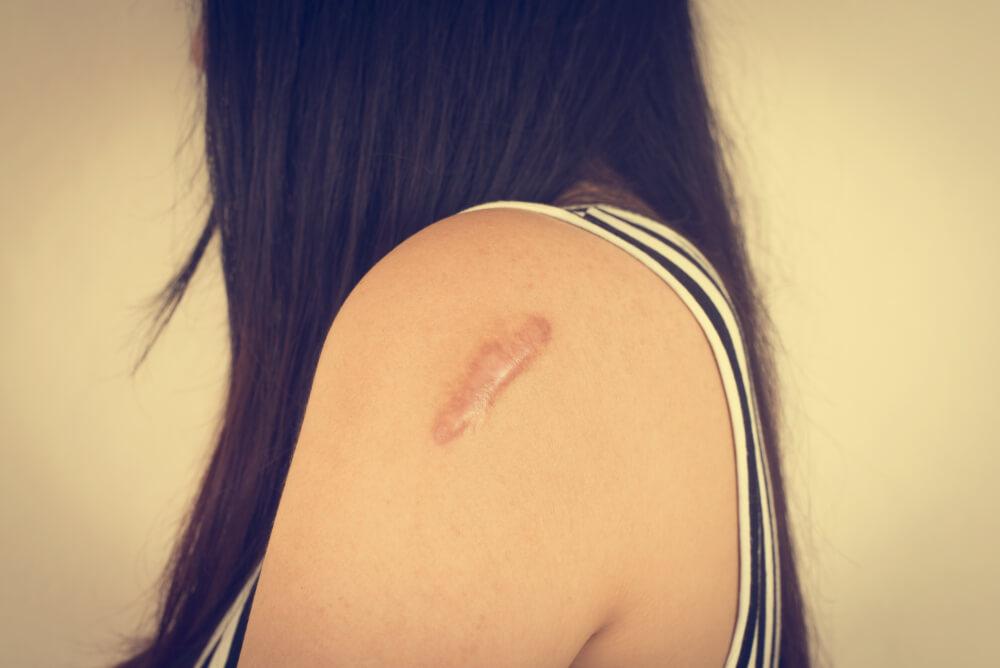
Keloid scars are raised, often reddish-purple scars that extend beyond the original wound boundaries. These scars may continue growing over time and develop most often on areas with little underlying fatty tissue—the face, neck, ears, chest, or shoulders.

Contracture Scars 

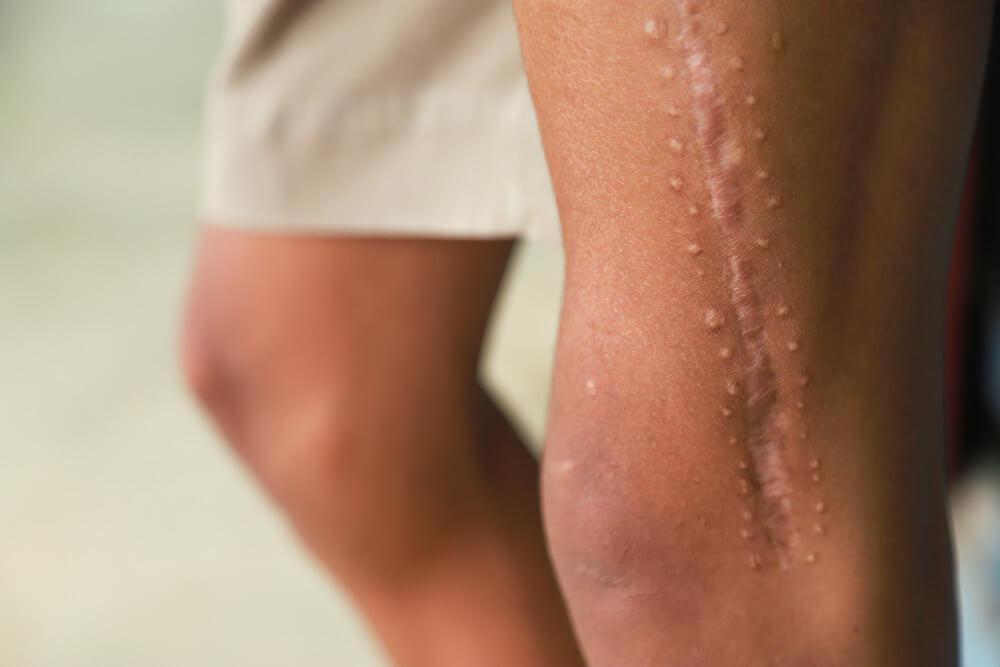
Contracture scars restrict movement because skin and underlying tissue pull together during healing. These scars happen when there’s significant tissue loss, such as after burns, or when wounds cross joints like fingers, elbows, knees, or neck.

Hypertrophic Scars 

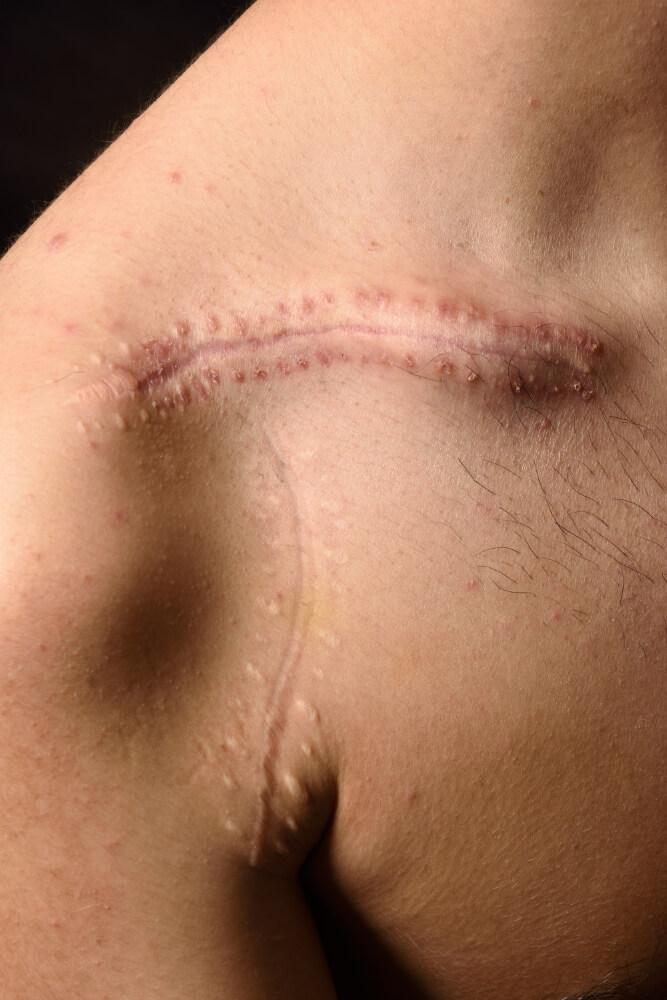
Hypertrophic scars are raised, red scars that stay within the boundaries of the original wound. Unlike keloids, these scars may improve over time but often benefit from revision procedures for better results.

Atrophic Scars 

Atrophic scars are depressed or sunken scars that sit below the surrounding skin surface. These usually result from acne, chickenpox, or surgical procedures.

Are You a Candidate for Body Scar Revision?

Good candidates for body scar revision include people who:

  • Have fully healed scars (usually at least 12-18 months old)
  • Don’t smoke or are willing to quit before surgery
  • Are in good overall health
  • Have realistic expectations about treatment outcomes
  • Experience physical discomfort or restricted movement from scarring
  • Feel self-conscious about visible scars

Good health and realistic expectations are important for successful outcomes.

Body Scar Revision Techniques 

Surgical Excision 

Surgical excision directly removes scar tissue through an incision. Stitches close the wound. This technique works well for small to medium-sized scars that can be removed and closed with careful suturing.

Z-Plasty and W-Plasty 

Z-plasty and W-plasty reposition scars along natural skin lines. These methods make scars less noticeable while potentially improving movement restrictions caused by contractures.

Skin Grafting 

Skin grafting involves taking healthy skin from another body area (the donor site) and attaching it to the treatment area. This technique is necessary for large scars or areas with significant tissue loss.

Tissue Expansion 

Tissue expansion increases the amount of existing tissue available for reconstruction. An inflatable balloon called a tissue expander is placed under the skin near the scar site. Over time, the balloon is slowly filled with sterile solution to expand the area of healthy skin. Once the skin has been stretched enough, the expander and scar are removed and the stretched skin replaces the scar tissue.

Laser Resurfacing 

Laser treatments smooth scars, remove abnormal scar color, or flatten raised scars. Laser therapy for keloid scars is often used along with other treatments, including steroid injections and specialized dressings.

Injectable Treatments 

Dermal fillers fill depressed or concave scars. Depending on the injectable substance and scar conditions, results may last from three months to several years. Steroid-based injections reduce collagen formation and can change the appearance, size, and texture of raised scar tissue.

What will be the Process of Body Scar Revision? 

Initial Consultation 

During your consultation, our surgeons evaluate your scar, discuss your goals, and recommend the most appropriate treatment approach. You’ll provide a complete medical history, including information about previous surgical procedures, past and present medical conditions, and any medications or supplements you’re taking.

Pre-Operative Preparation 

Before your procedure, you’ll receive detailed instructions about:

  • Medication adjustments
  • Smoking cessation requirements
  • Pre-surgical testing
  • Day-of-surgery preparations

The Procedure 

Body scar revision may be performed under local anesthesia with sedation or general anesthesia, depending on the extent and location of treatment. Medications are given for comfort during the surgical procedure.


What will be the Recovery Process? 

Recovery from body scar revision is usually smooth and easy. Most patients return to their normal routines in one to two weeks. This depends on the scar’s size, location, and how much work was done.

Doctors usually take out stitches after three to four days for facial scars. For other body areas, it takes five to seven days.

During recovery, patients can expect mild swelling, slight discomfort, and activity restrictions to ensure proper healing. Pain is generally well-controlled with prescribed medications, and follow-up visits help monitor progress and healing.

Will there be any Risk in Body Scar Revision?

Scar revision surgery is generally safe when performed by experienced specialists, and complications are uncommon. However, as with any surgical procedure, certain risks may occur. These can include minor bleeding, temporary discomfort or pain, mild reactions to sutures, and, in rare cases, infection or delayed wound healing. Over time, a few patients may also experience changes in pigmentation, new or recurrent scar formation, or slight alterations in skin texture or sensation. Possible risks include:

  • Bleeding or discomfort at the surgical site
  • Reaction to suture material
  • Infection or delayed healing
  • Skin pigment changes or mild atrophy
  • Development of a raised (hypertrophic) scar
  • Nerve sensitivity or temporary numbness
  • Subtle contour irregularities such as a “trap-door” effect

At Seattle Plastic Surgery, we take every step to reduce risks. We do this through careful pre-operative evaluations and precise surgical techniques. Our operating rooms are sterile, and we provide personalized post-care instructions. This helps ensure the best healing and natural-looking results.

Interested in a  Body Scar Revision

    Best time to contact? AnytimeMorningAfternoonEvening

    Why Choose Seattle Plastic Surgery? 

    Our well-known plastic surgeons, Dr. Craig Jonov and Dr. Tarak Patel, combine their artistic skills with precise surgery. They create results that look natural. At Seattle Plastic Surgery, the facility offers:- 

    • State-of-the-art surgical facilities
    • Personalized treatment plans
    • Proven scar revision techniques
    • Thorough pre and post-operative care
    • Convenient locations throughout the region

    Our commitment to patient satisfaction and safety has made us a trusted choice for scar revision procedures.


    Schedule Your Consultation Today 

    Body scar revision offers a path to improved appearance and renewed confidence. Our expert surgeons Dr. Jonov and Dr Patel, understand that every scar is unique, providing personalized treatment plans tailored to your specific needs. Patients can also check prices for each procedure using the Price Simulator. 

    Contact Seattle Plastic Surgery at 206-324-1120 or submit an online consultation request form to schedule your confidential consultation. Our experienced team will guide you through every step of your scar revision journey, from initial evaluation through final results.

    Frequently Asked Questions 

    How soon after an injury or surgery can I have scar revision? 

    Most surgeons recommend waiting at least one year before considering scar revision. Scars need time to mature and gain strength. Because of continuous collagen remodeling, it takes around 12-18 months for scars to mature and reach 70-80% of uninjured skin’s tensile strength. For the best results, revision surgery is performed after the scar has fully matured.

    Will insurance cover body scar revision? 

    Insurance coverage depends on whether the scar causes functional problems or is purely cosmetic. Scars that restrict movement or cause pain may qualify for coverage. Our staff can help verify your benefits and determine coverage eligibility.

    Can all scars be completely removed? 

    Scars can’t be completely erased. Scar revision improves the appearance of scars and makes them less noticeable, but doesn’t remove them entirely. Some scars may need several surgeries and extra treatments. This can help achieve the best results over many months or years.

    How many treatments will I need? 

    The number of treatments depends on your scar type, size, location, and desired outcome. One treatment may work well for some people. However, others might need several treatments to reduce the scar’s appearance.

    What is the recovery time for body scar revision? 

    Most people return to normal activities within 1-2 weeks after surgery. Complete healing takes several months to a year. Recovery time varies based on the type, extent, and location of the scar revision procedure.

    Are the results permanent? 

    Scar revision results are generally long-lasting. Your body’s healing response and proper aftercare play important roles in maintaining improvements. Following post-operative care instructions carefully helps ensure the best possible long-term results.

    What should I expect during the consultation? 

    During your consultation, our surgeons will look at your scar. They will talk about your medical history and your goals. They will also explain the treatment options available. You’ll receive information about the recommended procedure, expected outcomes, recovery process, and associated costs.

    Does scar revision surgery hurt? 

    The medical team performs the procedure under anesthesia, so you won’t feel pain during surgery. After the procedure, you may feel mild to moderate discomfort, and you can manage it with prescribed pain medications. Most people report that discomfort is manageable and subsides within the first week.

    Ready to Feel Comfortable in Your Skin?

    Schedule an appointment with Dr. Jonov at Seattle Plastic Surgery today. Contact us at (206) 739-0355, book online, or text us for further details.